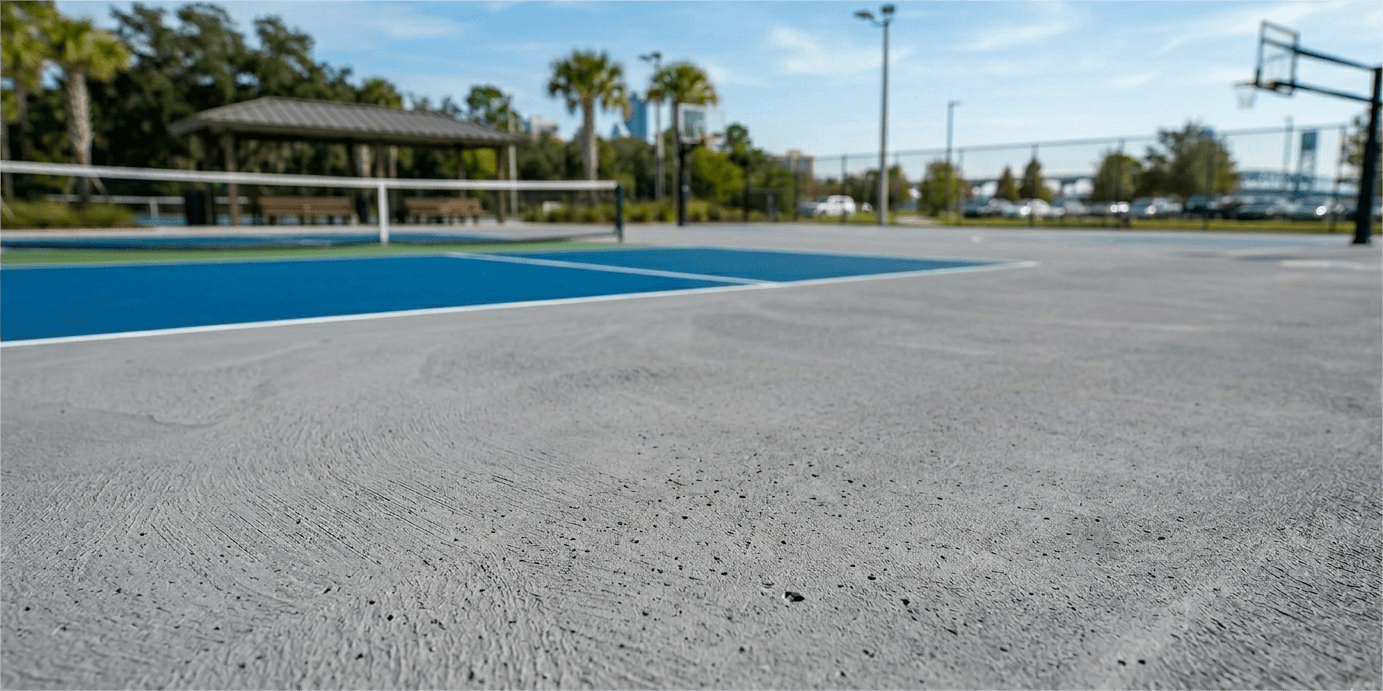
A basketball doesn’t lie. If the slab underneath isn’t flat, you’ll feel it in the dribble. Dead spots where the concrete dipped. Weird bounces where one section settled higher than the next. Water puddles that sit for days after it rains because nobody graded the base right. We’ve ripped out backyard courts around Jacksonville that were less than five years old because the original crew treated it like a driveway pour and called it done.
LCE Concrete Contractor Jacksonville pours sport court slabs — basketball courts, pickleball courts, multi-sport pads, and practice areas. Four years in business across Jacksonville, FL. Licensed, bonded, insured. 5-star Google rating. We know what a sport court slab requires that a regular slab doesn’t, and we don’t cut those corners.
Call or text for a free estimate. We answer the same day.
People assume concrete is concrete. Pour it flat, let it dry, paint some lines on it. That thinking is exactly how bad courts get built.
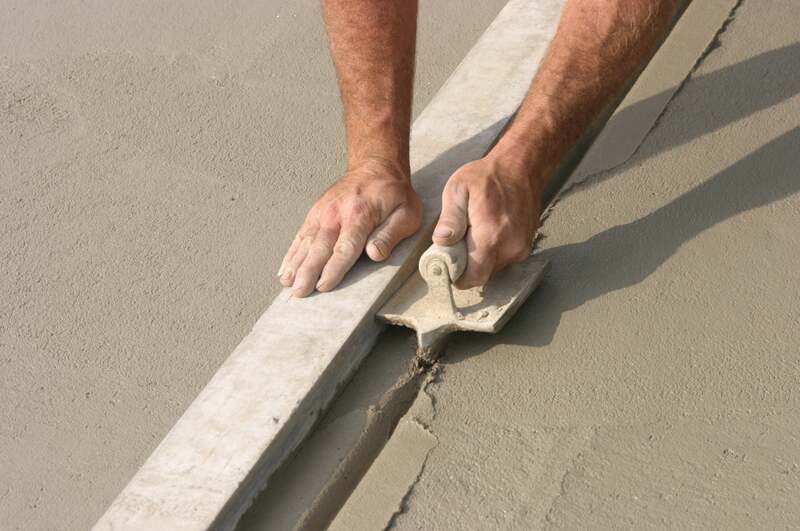
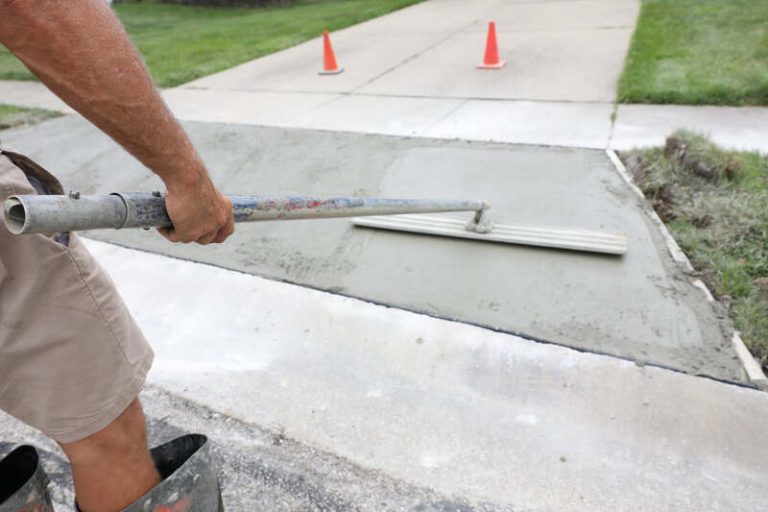
A sport court slab has tighter tolerances than almost any other residential pour. The surface needs to be flat within 1/8 inch over 10 feet. That’s not eyeballed — that’s checked with a straightedge and a level during the finish. A driveway can be off by a quarter inch and nobody notices. A basketball court that’s off by a quarter inch sends every dribble sideways.
Drainage has to be engineered into the slope without making the playing surface feel tilted. We pitch the slab just enough for water to sheet off — usually about 1 percent grade — but not so much that you feel like you’re running uphill on one end. Getting that balance right takes planning, not guessing.
Thickness is 5 inches minimum with rebar on a tight grid. These slabs take impact. Jumping, running, dropped weights if it’s a workout area. The repeated pounding breaks down thin concrete fast, especially in Jacksonville where the heat makes everything expand and contract more than it would up north.
Court concrete in Jacksonville runs between $8 and $16 per square foot for the slab alone. That doesn’t include surface coating, striping, or any fencing or accessories — just the concrete pad.
What moves that number: court size, thickness, reinforcement, soil conditions, access for the concrete truck, and how much site work we need to do before we can even set forms. A half-court basketball pad in a flat backyard with good access is straightforward. A full-size multi-sport court on a sloped lot with soft soil and a tight gate we have to pump concrete through — that’s a different job and a different price.
Here’s what a few common sizes look like:
A 30×30 half-court basketball pad runs roughly $7,000 to $14,000 for the concrete. A 30×60 full pickleball court is in the $14,000 to $28,000 range. A 50×94 full basketball court — if you’ve got the space — gets into the $35,000-plus territory for the slab.
We quote after a site visit. Always free. Written estimate with the real number, not a per-square-foot guess that balloons once we start finding problems in the dirt.
Basketball — half and full court.
Half courts are the most popular backyard build in Jacksonville. 30×30 or 30×50 depending on how much space you’ve got. Full courts need more room than most residential lots can give, but we’ve done them on larger properties and for private clubs.
Pickleball courts.
The playing area is 20×44 but you need buffer zones on all sides — a proper pad is at least 30×60. We’re pouring a lot of these right now. Pickleball took off and half the neighborhoods in Jacksonville have somebody building a court in their backyard.
Multi-sport pads.
One slab, multiple line sets. Basketball and pickleball on the same court is the most common combo. We pour the slab to the dimensions that work for both sports and the surface coating company handles the striping.
Batting cages and practice areas.
Flat slab with proper drainage. Some want a smooth finish for indoor-style turf overlay, others want broom finish for bare concrete use. We pour to whatever spec the final surface needs.
Shuffleboard and bocce.
Smaller pads but they still need dead-flat concrete with the right finish. Shuffleboard especially — any high spot or dip and the puck rides off line.
The slab is only as good as what’s under it. And sport courts are less forgiving than any other type of concrete work because the surface tolerances are so tight.
Jacksonville’s soil is mostly sand and sandy clay. Sand drains well but it erodes. Clay holds water and swells. Either one will move a slab if you don’t handle it. We excavate to depth, proof-roll the subgrade to find soft spots, and fill and compact any areas that aren’t solid. Then we lay a minimum 4-inch compacted aggregate base — more if the soil’s questionable.
On sloped lots, we cut and fill to get the pad area level before we even think about forming. A court that follows the natural grade of a sloped yard is useless. We bench it flat, build up the low side with engineered fill, and compact the entire base to a consistent density.
Drainage around the court matters as much as drainage on it. We grade the surrounding area so rainwater flows away from the slab edges, not under them. Water getting under a sport court slab is how you get voids, settling, and cracks six months later.
We pour the slab. The surface coating is a separate step, usually done by a specialty sport court company after the concrete has cured for at least 28 days.
Here’s what you need to know so you’re not surprised.
The concrete slab we pour is the structural base. It’s broom-finished or smooth-finished depending on what coating system goes on top. Most acrylic sport court coatings — like the ones from SportMaster, DecoTurf, or similar brands — need a specific surface profile to bond correctly. We finish the slab to match whatever coating system you’re planning to use.
We’ll coordinate with your coating contractor if you’ve already picked one. If you haven’t, we can point you toward a couple of outfits in Jacksonville that do good work. The coating, color, and line striping are their scope — the flat, structurally sound slab underneath is ours.
Some customers skip the coating and just use the bare concrete. Works fine for casual shooting around. But coated surfaces play better, drain faster, and last longer because the coating protects the concrete from UV and moisture.
We’ve poured enough courts to know where the problems happen — and they almost always happen in the base prep and the finishing. Soft spots in the subgrade that nobody checked. Concrete that set up too fast in the August heat because the crew wasn’t ready. Joints cut in the wrong spots that telegraph through the surface coating.
We don’t rush pours. We check the base before we form. We check the forms before we pour. And we check flatness during the finish, not after.
Family-owned, veteran-owned. Our crew does the work — no random subs. Licensed, insured, and we back it with a written guarantee. We’ve held a 5-star Google rating because the courts we pour play right and stay right.
Anywhere in the Jacksonville metro — Mandarin, Southside, Arlington, Riverside, San Marco, the Beaches, Westside, Northside. Also Orange Park, Fleming Island, Ponte Vedra, and St. Augustine.
We’ve poured courts on residential lots, at private schools, for church youth groups, and at small community rec areas. If you’ve got the space and the slab needs to be right, we’re the crew.
Don’t put it on a slab that was poured like a patio. Call LCE Concrete Contractor Jacksonville for a free estimate anywhere in the Jacksonville, FL area. We’ll build the base your court actually needs.
Five inches minimum with rebar reinforcement. Larger courts or courts expecting heavy use may need 6 inches. The slab has to handle repeated impact loading — running, jumping, dropping — without cracking or settling. We don’t pour sport courts at 4 inches. It’s not enough.
Within 1/8 inch over any 10-foot span. That’s the industry standard for a playable surface. Anything more and you’ll get dead spots, bad bounces, and puddles. We check flatness with a straightedge during finishing, not after the concrete’s hard and it’s too late to fix.
The slab needs 28 days to reach full strength. If you’re having a surface coating applied, that happens after the 28-day cure. Most coating systems need another few days to cure after application. Figure 5 to 6 weeks from pour day to first game, depending on your coating contractor’s schedule.
Yes. We cut and fill sloped lots to create a level building pad for the court. It adds to the site prep cost but it’s standard work for us. The finished court will be flat and level regardless of what the natural grade looks like.
Usually no for the concrete pad itself, but it depends on your lot and any HOA restrictions. If you’re adding fencing, lighting, or structures around the court, those may trigger permits. We’ll help you figure out what’s needed before we start.
Yes. We cut control joints in a grid pattern based on the slab dimensions. Joint placement on a sport court is more critical than on a regular slab because the coating has to bridge those joints cleanly. We coordinate joint layout with the coating system requirements so nothing telegraphs through to the playing surface.
Call or text. We come out, look at the site, talk about court size and type, and hand you a written quote. Free, no pressure. If you’ve already got a coating contractor lined up, bring their specs — we’ll make sure the slab meets their requirements.