A cracked commercial sidewalk is a liability claim waiting to happen. Somebody catches a toe on a raised section outside your storefront, goes down hard, and now you’re dealing with lawyers instead of customers. We get calls every week from property owners and managers in Jacksonville who ignored a sidewalk problem for too long and now they’re in a rush because their insurance company or their attorney told them to fix it yesterday.
LCE Concrete Contractor Jacksonville pours and replaces commercial sidewalks for strip malls, office parks, apartment complexes, churches, HOAs, retail centers, and municipal properties across Jacksonville, FL. Licensed, bonded, insured. Four years in business. 5-star Google rating. We know Jacksonville’s code requirements, we know what the inspectors check, and we pour it right so you’re not doing it again in five years.
Call or text for a free estimate. Same-day response.
A residential front walk is 3 feet wide and runs 20 feet from the driveway to the porch. A commercial sidewalk might run 500 linear feet around a shopping center with ADA ramps at every curb cut, transitions at every building entrance, and a hundred people walking on it before lunch.
The specs are different. Minimum 5-inch thickness on most commercial applications. Rebar or heavy wire mesh reinforcement. ADA-compliant slopes on every section — running slope, cross slope, level landings at doors, truncated dome panels at curb ramps. Joint spacing calculated for the slab dimensions so cracks go where we tell them to and not through the middle of a handicap ramp.
The stakes are different too. A homeowner’s cracked walkway is an eyesore. A commercial sidewalk failure is a code violation, an ADA complaint, and a personal injury claim all rolled into one. We build for the worst-case scenario because in commercial work, the worst case actually shows up.
We walk the property with you or your property manager, mark what’s coming out, identify ADA deficiencies, note utility conflicts, and measure everything. If there’s an engineering drawing or site plan, we work from that. If there isn’t one, we create a scope document so everybody knows exactly what’s getting poured and where.
We cut clean lines at the edge of every removal section. The concrete on the other side of that cut stays intact. Old sidewalk gets broken out, loaded, and hauled to a recycling facility. Rebar gets separated and recycled. Your property doesn’t become a debris storage yard.
Subgrade gets excavated to depth, graded, and compacted. Aggregate base goes down and gets compacted in lifts. Around Jacksonville, we’re usually dealing with sandy soil that drains fast but erodes if it’s not packed right. On commercial sidewalks, base failure shows up as a settled section that holds water and trips people. We don’t let that happen.
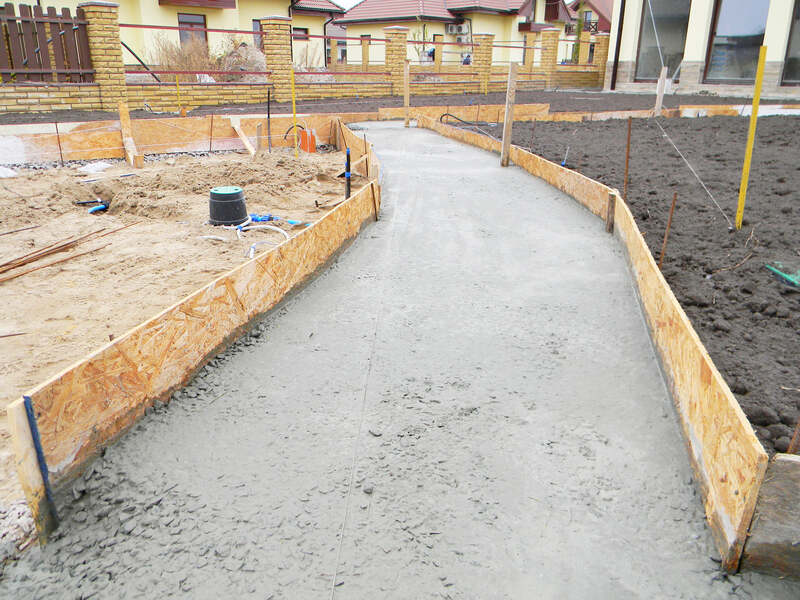
Forms set to the correct grade and cross slope. Rebar tied on chairs at the right height. ADA ramp forms built to spec with the correct slope ratios. Dowels drilled into existing concrete where new sections tie in.
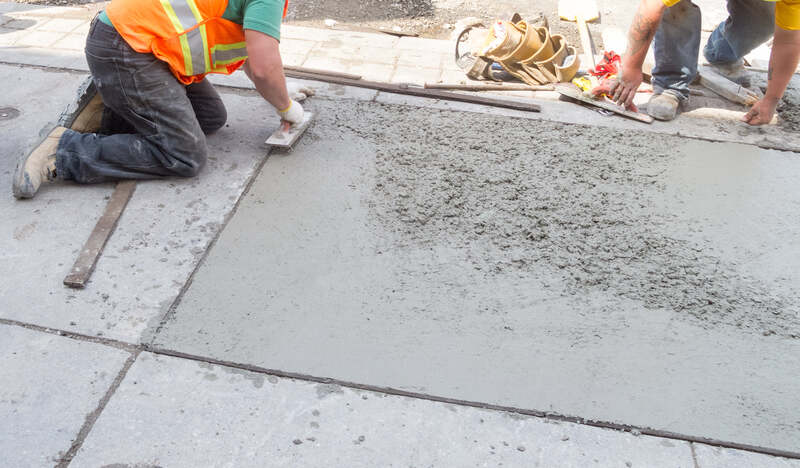
Concrete placed, consolidated, screeded, and finished. Broom texture for traction. Control joints saw-cut at the right intervals once the surface firms up. Edges tooled. Cure compound applied.
Barricades stay up until the concrete can handle foot traffic — usually 24 to 48 hours. We clean the work zone, pull the forms, backfill the edges, and your sidewalk is open.
Half the commercial sidewalk calls we get are because somebody poured a ramp wrong or forgot a truncated dome panel and the property failed an ADA audit. Now the owner is paying twice — once to rip out what the last guy did and once to have us do it correctly.
ADA requirements on commercial sidewalks aren’t suggestions. They’re federal law. Here’s what has to be right:
Running slope on an accessible route can’t exceed 5 percent. Cross slope can’t exceed 2 percent. Curb ramps need a maximum 1:12 slope with level landings at the top. Truncated dome detectable warning surfaces at every curb ramp where pedestrians cross a vehicular path. Minimum 5-foot clear width on accessible routes. Level landings at building entrances.
We check slope with a digital level during the pour — not after. If a ramp’s running at 9 percent instead of 8.3, we fix it while the concrete is still wet. Checking it after it’s cured means you’re breaking it out and starting over.
We’ve poured ADA-compliant sidewalks and ramps for commercial properties all over Duval County. We know the numbers, we check them in real time, and we document them for your records.
Commercial sidewalk concrete in Jacksonville runs between $8 and $16 per square foot depending on scope.
Lower end: standard broom-finish sidewalk replacement with good access, decent soil, and no major ADA ramp work. Higher end: new sidewalk installation with multiple ADA ramps, curb cuts, truncated dome panels, poor soil, extensive demo of old concrete, and tight site access that requires pumping concrete.
Linear footage is usually how commercial sidewalk jobs get estimated since most walks are a consistent width. A 5-foot-wide sidewalk at $10 per square foot works out to $50 per linear foot. Run that along a 200-foot building frontage and you’re at $10,000 for that stretch.
Curb ramp construction adds cost. Each ramp — with forming, grading, rebar, truncated domes, and the level landing — typically runs $1,500 to $3,500 depending on complexity and whether we’re tying into existing curbing or pouring new.
We quote every job after a site walk. Free estimate, written, detailed. No square-foot ballparks tossed out over email.
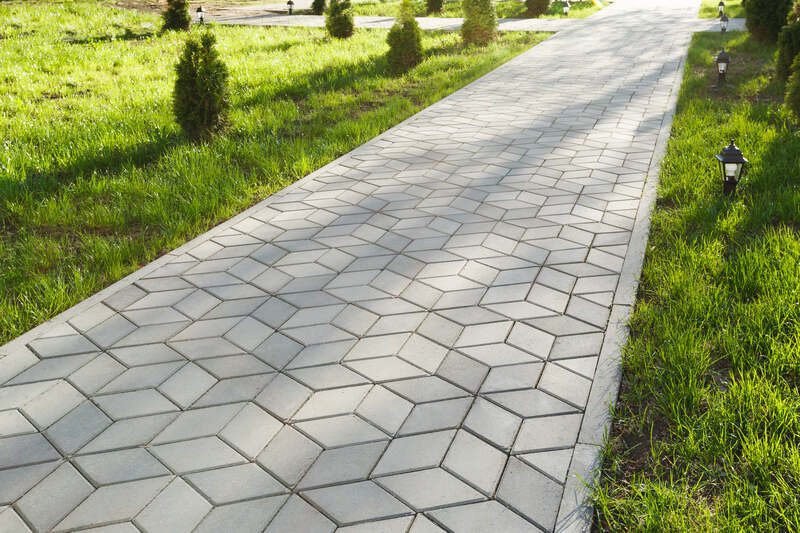
Sometimes the whole sidewalk is shot. Twenty years of tree roots, settling, and wear, and there’s not a flat section left on the property. That’s a full tear-out and repour.
But a lot of commercial sidewalk jobs are section replacements. Panels 4 through 9 have settled and cracked. Panel 12 has a tree root pushing it up. The ramp at the south entrance fails ADA slope. Everything else is fine.
We saw-cut the bad sections out, leave the good concrete alone, fix the base, and pour new panels that match the existing grade, thickness, and finish. Dowel the new into the old so the joint between them doesn’t move. Done right, you can’t tell which sections are new after a few months of weathering.
Section replacement saves money and disruption. You’re not tearing out 2,000 square feet of sidewalk when 500 square feet is the actual problem. We’ll walk the property with you and mark exactly what needs to go and what can stay.
Live oaks. They’re everywhere in Jacksonville and their root systems don’t care about your sidewalk. A root will grow under a 5-inch slab and lift it three inches off the ground in a few years. We see it on almost every commercial property that has mature trees near the walkways.
Fixing it isn’t as simple as pulling the old concrete and pouring new on top of the same roots. The roots will do the same thing again. We have a few ways to handle it depending on the situation.
Root pruning and barriers. If the tree is healthy and worth keeping, we can prune the offending roots — with guidance from an arborist if the tree’s significant — and install a root barrier between the tree and the new sidewalk. The barrier redirects root growth downward instead of laterally under the slab.
Rerouting the sidewalk. Sometimes the best answer is to move the walk. Shift it 3 feet away from the tree trunk and the root zone, and the problem goes away. Costs a little more in concrete but saves you from fighting the same roots every decade.
Bridging. On large root systems that can’t be cut, we can form the sidewalk to bridge over the root zone with a thickened, reinforced section that spans the roots without sitting on them. Not always practical but it works in specific situations.
We’ll look at your tree situation and recommend the approach that actually solves the problem long-term. Pouring new concrete over the same roots and expecting a different result isn’t a plan — it’s a waste of your money.
Our crew does the work. Not a revolving door of subcontractors who’ve never seen your property before. The guy you talked to during the estimate is connected to the guys running the pour.
your management company, your GC, your building owner. Licensed, bonded. 5-star Google rating. Written workmanship guarantee on every job.
We’ve poured commercial sidewalks for properties across Jacksonville and we haven’t had an ADA ramp fail inspection yet. That’s not luck — it’s checking the slope before the concrete gets hard
Commercial sidewalk work across Jacksonville — Downtown, Southside, Arlington, Mandarin, Westside, Northside, Riverside, San Marco, the Beaches, Town Center, Regency, Baymeadows corridor. Also Orange Park, Fleming Island, Ponte Vedra, and St. Augustine.
If your commercial property has sidewalks that are cracked, settled, heaved, or out of ADA compliance, call us before it becomes a bigger problem.
Call LCE Concrete Contractor Jacksonville for a free estimate on commercial sidewalk work anywhere in Jacksonville, FL. We’ll get it poured right, poured to code, and off your worry list.
A small section replacement — a few panels and a ramp — can be done in a day or two. A full sidewalk replacement around a large commercial property might take one to two weeks. We phase the work so pedestrian access is maintained throughout the project.
Yes. Any sidewalk associated with a place of public accommodation — retail, office, medical, restaurant, multifamily, church — has to meet ADA accessibility standards. That includes width, slope, surface texture, curb ramps, and detectable warnings. We build all of it to spec.
On private commercial property, the owner is responsible for all sidewalks. Sidewalks in the public right-of-way along your property frontage may fall under city jurisdiction, but the city sometimes bills the adjacent property owner for repairs. We can pour either way — just confirm who’s authorizing and paying for the work.
We match the thickness, finish, and grade. Fresh concrete is always lighter in color than weathered concrete — that’s just how it works. Within 6 to 12 months of sun exposure, the color difference fades and the new sections blend in with the old.
Between $8 and $16 per square foot depending on the scope. Section replacements on the lower end, full new installations with ADA ramps and curb cuts on the higher end. Curb ramps run $1,500 to $3,500 each. We give detailed written estimates after a site visit — free, no obligation.
All the time. We carry the insurance, provide the certificates, and coordinate with your schedule and your other trades. If we’re subbing under a GC, we hit our dates. If we’re working directly for a property manager, we communicate progress and keep the site clean.
Call or text. We’ll set up a site walk, go over the scope, and hand you a written estimate. If you’ve got a site plan or an ADA audit report, bring it — it speeds up the process. No charge for the estimate, no pressure to commit on the spot.